(UPDATE: Jemod McCoy suffered a torn ACL in January 2025, and his recovery has been a key topic leading up to the draft. According to multiple reports, some teams have labeled McCoy’s knee as degenerative. According to Pro Football Doc, the ACL itself was never the main concern. The bigger issue is the associated damage around the knee, which is far more important to the long-term outlook. Reports of a “plug” suggest full-thickness cartilage loss, and that raises major questions about durability and longevity. If there is also a possibility he could need another graft in the future, that is an ominous sign and the kind of detail teams would weigh heavily when evaluating his long-term value.)
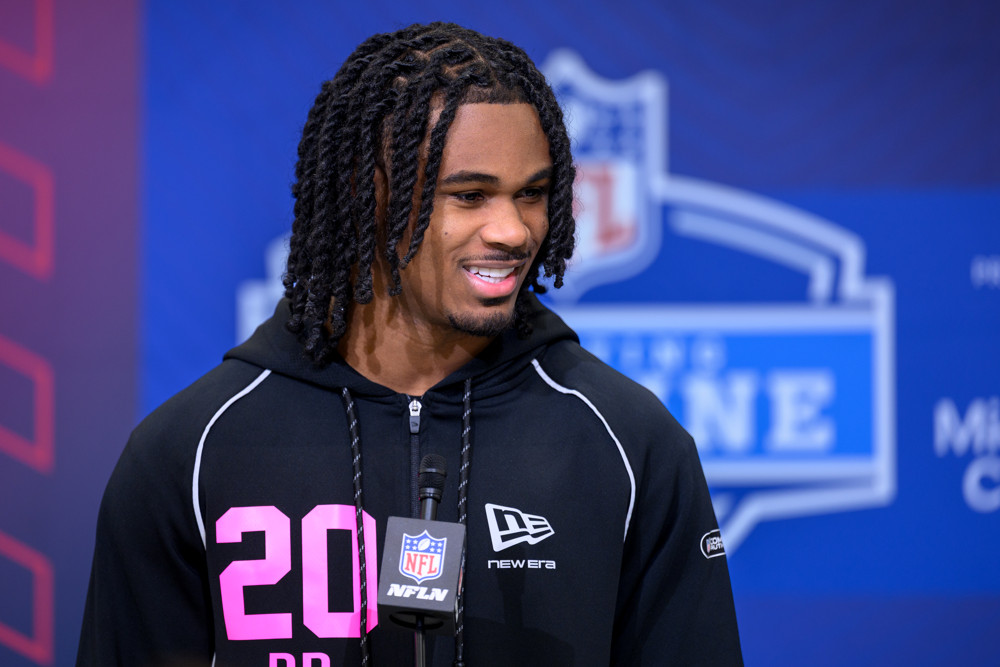
Tennessee cornerback Jermod McCoy enters the 2026 NFL Draft as one of the more medically driven evaluations in the class, with his talent firmly cementing a first-round grade while his injury history introduces the only real variable. At 6’0”, 193 pounds with an ADP of 13.7 (CB2), McCoy’s last on-field production came during a dominant 2024 season following his transfer from Oregon State to Tennessee. That year, he earned Second-Team All-American honors, First-Team All-SEC recognition, and was one of 15 players selected for Jim Thorpe Award consideration. However, a torn ACL suffered during a January 2025 offseason workout sidelined him for the entire 2025 season, leaving evaluators without recent game film and forcing a projection-based assessment centered around his recovery.
From a performance standpoint, McCoy’s 2024 tape supports a clear first-round profile. He displays high-level man coverage ability, fluid hips, and the recovery speed necessary to stay attached to vertical routes. His instincts and ball skills consistently show up against top SEC competition, and his physicality at the catch point suggests he can match up with bigger NFL receivers. The Tyson Campbell comparison is fitting—both players possess similar size, long speed, and technical upside, with McCoy arguably showing more natural playmaking instincts coming out. His ability to mirror and close space quickly makes him scheme-versatile, capable of thriving in both press-man and off-coverage systems.
The primary evaluation hinge is his ACL recovery and how teams interpret both the timeline and his post-injury testing. At roughly 13+ months removed from surgery, McCoy falls within the modern recovery window where players are typically cleared for full activity. Importantly, he chose to bypass the NFL Combine not due to setbacks, but to control his testing environment and timeline, instead participating in Tennessee’s Pro Day. The results were strong: a 4.38 forty-yard dash, 38-inch vertical, and 10’7” broad jump—numbers that indicate he has regained explosiveness, which is often the final piece to return after ACL reconstruction. Straight-line speed testing at that level is a strong indicator that his lower-body power has returned close to baseline.
However, from an injury analytics perspective, teams will go beyond raw testing numbers. The key concerns with ACL recoveries—particularly for cornerbacks—are not just speed, but change-of-direction efficiency, hip fluidity, and confidence in reactive movements. These traits are harder to fully validate without live game reps, which McCoy lacks in 2025. Medical evaluations will focus heavily on ligament stability, symmetry between legs, and whether there are any compensatory mechanics that could increase future injury risk. Additionally, while modern ACL recoveries are highly successful, it is common for players to take a full season of game action before returning to true pre-injury form.
This creates a classic projection scenario. McCoy’s ceiling remains that of a true CB1 with elite athletic traits and proven high-level production, but teams must weigh the short-term uncertainty. In year one, there may be some inconsistency as he reacclimates to live NFL speed and movement demands. Long-term, if the medicals check out clean, there is little reason to believe the injury will significantly cap his trajectory.
Ultimately, McCoy’s draft position will be dictated almost entirely by team medical evaluations. His 2024 tape already justifies a top-15 selection, and his Pro Day testing reinforces that his athletic profile remains intact. The only question is how comfortable teams are projecting forward without a 2025 sample. In a premium position like cornerback, where athletic traits and coverage ability are highly valued, it only takes one team to trust the recovery for McCoy to solidify himself as a first-round pick.
As the 2026 NFL Draft approaches, teams are doing more than just reviewing game tape; they're digging deep into medical histories. While talent is paramount, durability is critical in a league where physical attrition is a weekly reality. Several top prospects enter the draft with injury concerns that could affect their stock, especially as teams weigh short-term availability against long-term risk.
At SIC, we’ve analyzed the most notable health-related storylines among top NFL hopefuls, using both medical insight and positional value to assess how injuries could shape their draft outcomes.
Check out the 2026 NFL Draft Injury Guide
Sign up to our FREE Weekly Newsletter here for all of our best injury-insights, free injury-based picks and special discount offers!