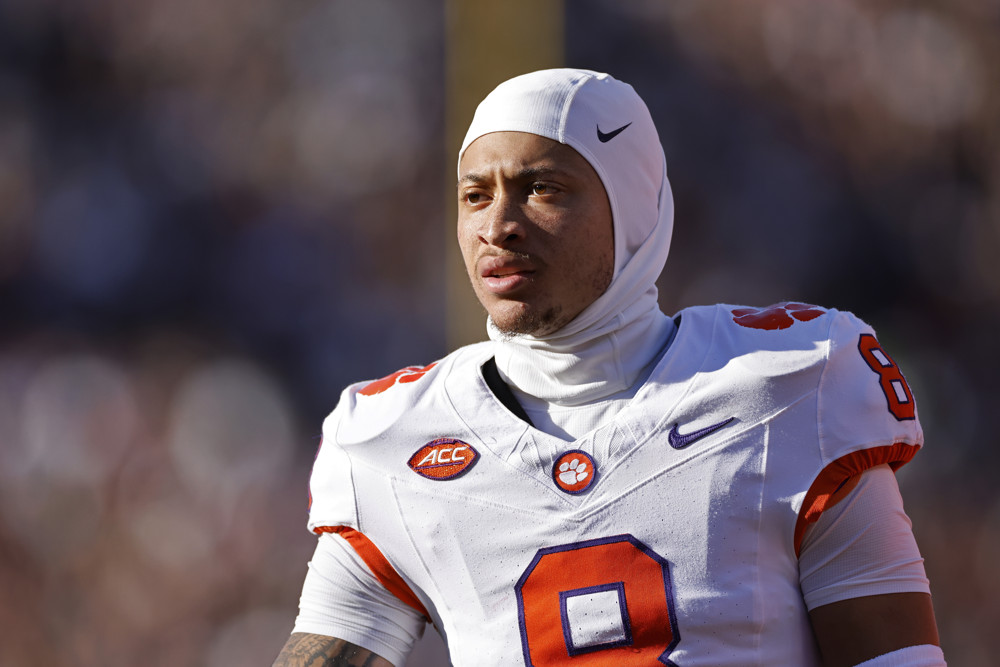
Aveion Terrell entered the pre-draft process with legitimate first-round buzz, but a poorly timed hamstring injury has quickly shifted the conversation from ceiling to short-term availability. The Clemson corner initially pulled his hamstring during position drills at the NFL Combine, forcing him to shut down for agility testing and ultimately skip Clemson’s Pro Day. In an effort to make up for lost evaluation opportunities, Terrell held a personal Pro Day on March 30—but aggravated the same hamstring on his first rep, reinforcing concerns about a lingering soft-tissue issue at the worst possible time.
From an injury evaluation standpoint, this profiles as a classic “nagging” hamstring strain rather than something structurally concerning long term. The re-aggravation suggests he never fully returned to baseline before ramping back up, which is common in pre-draft settings where prospects push timelines to showcase athleticism. For teams, the issue isn’t long-term durability—it’s the lack of verified athletic testing and the inability to see him move at full speed in a controlled setting. That matters more for a cornerback, where short-area burst, recovery speed, and fluidity directly translate to draft capital.
The good news is that Terrell does not carry a concerning injury history beyond this hamstring issue. There are no chronic lower-body concerns, no prior soft-tissue patterns, and nothing to suggest this will linger into the season. With proper rest and a full rehab cycle, this is the type of injury that should be fully resolved well before training camp. Expect him to be ready for rookie minicamp, with no limitations by the time the regular season approaches.
From a draft impact perspective, however, the damage may already be done. Missing the Combine testing window, sitting out Clemson’s Pro Day, and then re-injuring himself in his lone opportunity to perform creates uncertainty for teams relying on measurable athletic thresholds. As a result, Terrell could slide out of the first round—not due to talent, but due to incomplete information. That said, this sets up a potential value opportunity. Much like other prospects who have fallen due to temporary injuries, Terrell still projects as a competitive, physical corner with strong tape and high-end traits.
The bottom line: this is a short-term availability issue, not a long-term medical red flag. Teams willing to trust the film over the testing numbers could land a high-upside corner at a discount. If anything, the hamstring situation may turn Aveion Terrell from a late first-round pick into one of the more intriguing “steals” in the 2026 NFL Draft.
As the 2026 NFL Draft approaches, teams are doing more than just reviewing game tape; they're digging deep into medical histories. While talent is paramount, durability is critical in a league where physical attrition is a weekly reality. Several top prospects enter the draft with injury concerns that could affect their stock, especially as teams weigh short-term availability against long-term risk.
At SIC, we’ve analyzed the most notable health-related storylines among top NFL hopefuls, using both medical insight and positional value to assess how injuries could shape their draft outcomes.
Check out the 2026 NFL Draft Injury Guide