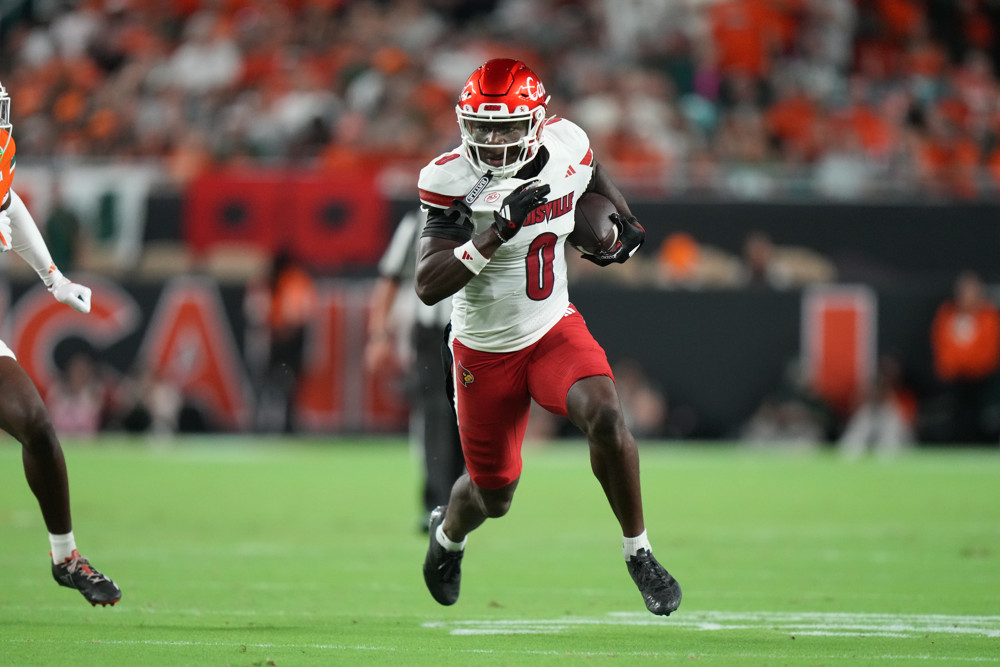
Louisville wide receiver Chris Bell enters the draft process as one of the more polarizing injury evaluations in this class, with his stock now hinging almost entirely on medical confidence rather than on-field production. Once trending toward the top-20 picks, Bell suffered a late-season ACL tear (with possible LCL involvement) in Week 13 against SMU (Nov. 22), a brutal timing hit for a prospect whose evaluation depended heavily on pre-draft testing. He underwent surgery in early December under renowned orthopedic surgeon Dr. Dan Cooper, notably the same physician tied to high-profile multi-ligament repairs like Patrick Mahomes, which adds credibility to the surgical outcome but does not eliminate the inherent uncertainty tied to multi-ligament knee injuries.
From a medical standpoint, the timing of Bell’s injury is critical. A mid-December surgery places him roughly 4–5 months post-op at draft time, well short of the typical 9–12 month return-to-play window for ACL recoveries—especially for explosive, high-load positions like wide receiver. The added concern is the potential LCL involvement, which, if confirmed, increases recovery complexity due to lateral knee stability demands, particularly for a player whose game is built on high-speed cutting, acceleration, and vertical explosiveness. Bell opted out of both the Combine and his Pro Day, leaving teams without verified testing metrics—an important gap for a prospect whose value is closely tied to elite athletic traits. While reported in-game GPS speeds in the low 4.3s and his 6’2”, 220+ frame suggest a rare physical profile comparable to Xavier Legette, the inability to confirm post-injury explosiveness keeps a major box unchecked.
That said, recent reports indicate Bell is progressing ahead of schedule, already running and jumping roughly five months post-op. While encouraging, early functional movement does not necessarily translate to full football readiness - particularly when it comes to regaining top-end speed, route sharpness, and confidence in lateral cuts. For teams, the key evaluation point will center around medical rechecks and long-term projection rather than immediate rookie-year impact. Even in optimistic scenarios, Bell is more likely to follow a gradual integration path early in his rookie season, with a higher probability of limited usage or delayed breakout potential.
Ultimately, Bell represents a classic high-risk, high-reward profile. His size-speed combination and prototype X-receiver traits still carry first-round upside, but the late-season ACL injury introduces both short-term availability concerns and long-term performance variability. If teams are satisfied with the integrity of the repair and his recovery trajectory, he could still sneak into the back end of Round 1. However, without verified athletic testing and with lingering questions about knee stability, Bell’s draft range is more realistically anchored in the late Round 1 to early Day 2 window, where medical risk is more appropriately priced into the evaluation.
As the 2026 NFL Draft approaches, teams are doing more than just reviewing game tape; they're digging deep into medical histories. While talent is paramount, durability is critical in a league where physical attrition is a weekly reality. Several top prospects enter the draft with injury concerns that could affect their stock, especially as teams weigh short-term availability against long-term risk.
At SIC, we’ve analyzed the most notable health-related storylines among top NFL hopefuls, using both medical insight and positional value to assess how injuries could shape their draft outcomes.
Check out the 2026 NFL Draft Injury Guide
Sign up to our FREE Weekly Newsletter here for all of our best injury-insights, free injury-based picks and special discount offers!